🌐Diese Seite ist noch nicht auf Deutsch verfügbar.

Sagent: the AI shopping assistant that turns browsing into buying

Sagent ends the choice overload, the walkouts, and the traffic that never converts, asking what your best salesperson would ask and framing the answer the way that gets a yes

Built on Crobox's own product discovery engine and over a decade of shopper psychology

What is an AI shopping assistant?

An AI shopping assistant is a conversational layer on an ecommerce site that helps a shopper work out what to buy, rather than helping them find something they can already name. It reads intent from plain language, asks a handful of clarifying questions, and narrows a catalog of thousands down to the two or three products that actually fit.

That's a different job from a support chatbot, which handles order status and returns, and a different job from site search, which needs the shopper to already know the vocabulary. An AI shopping assistant sits where the decision happens, and it's the part of the journey where choice overload quietly costs the most revenue.

Crobox has been solving that decision moment since 2014, first with guided product finders and now with Sagent. Both run on the same foundation: your product data, enriched into the language shoppers actually use, plus more than a decade of behavioral science about how people choose.

Everyone in guided selling claims a conversion lift. Sagent carries years of Crobox product discovery and guided selling into every conversation. We kept the receipts.
5.2x
return on investment
16x
return on investment
604%
increase in conversion rate

AI shopping assistant vs. chatbot vs. site search

These three get lumped together in RFPs and they solve different problems. Most ecommerce teams need all three; the mistake is expecting one to cover another's job.

Capability AI shopping assistant Support chatbot Site search
Understands a need described in the shopper’s own words Yes No No
Asks follow-up questions before recommending anything Yes No No
Explains why a product fits, not just that it matched Yes No No
Works from enriched product data, not raw spec fields Yes No No
Answers order status and returns questions No Yes No
Returns results instantly for a known product name No No Yes

The conversation

Every answer draws on your live catalog, enriched by Crobox Data Enrichment, so Sagent starts from real product understanding rather than a guess

Why most AI shopping assistants fail

Pointing a language model at a product feed is a weekend project. Getting it to recommend well is not, and the reason is almost always the data underneath it.

A feed says Gore-Tex, 4mm drop, 280g. A shopper says my feet get soaked on the commute. Nothing in the feed connects those two sentences, so the assistant guesses, and a confident wrong answer erodes trust faster than no answer at all.

Crobox Data Enrichment translates technical attributes into the benefits and situations shoppers describe, and keeps doing it as your catalog turns over. That's the part most teams underestimate when they scope an assistant in-house, and it's why Sagent starts from product understanding instead of a guess.

Powered by persuasion science

Sagent's recommendations draw on Crobox's decade-plus of behavioral science, framed the way consumer psychology moves a decision, not just stated as fact. Your team decides which principles apply, and how strongly

Every conversation, watched and scored

You'll know what's happening in every conversation, and why

Monitoring

Every conversation is scored and flagged before it becomes a problem, on a dashboard you can customize with your own favorite metrics and charts

Ask Analytics

Ask what shoppers compared or which question kept coming up, and get the answer back as a chart, instantly
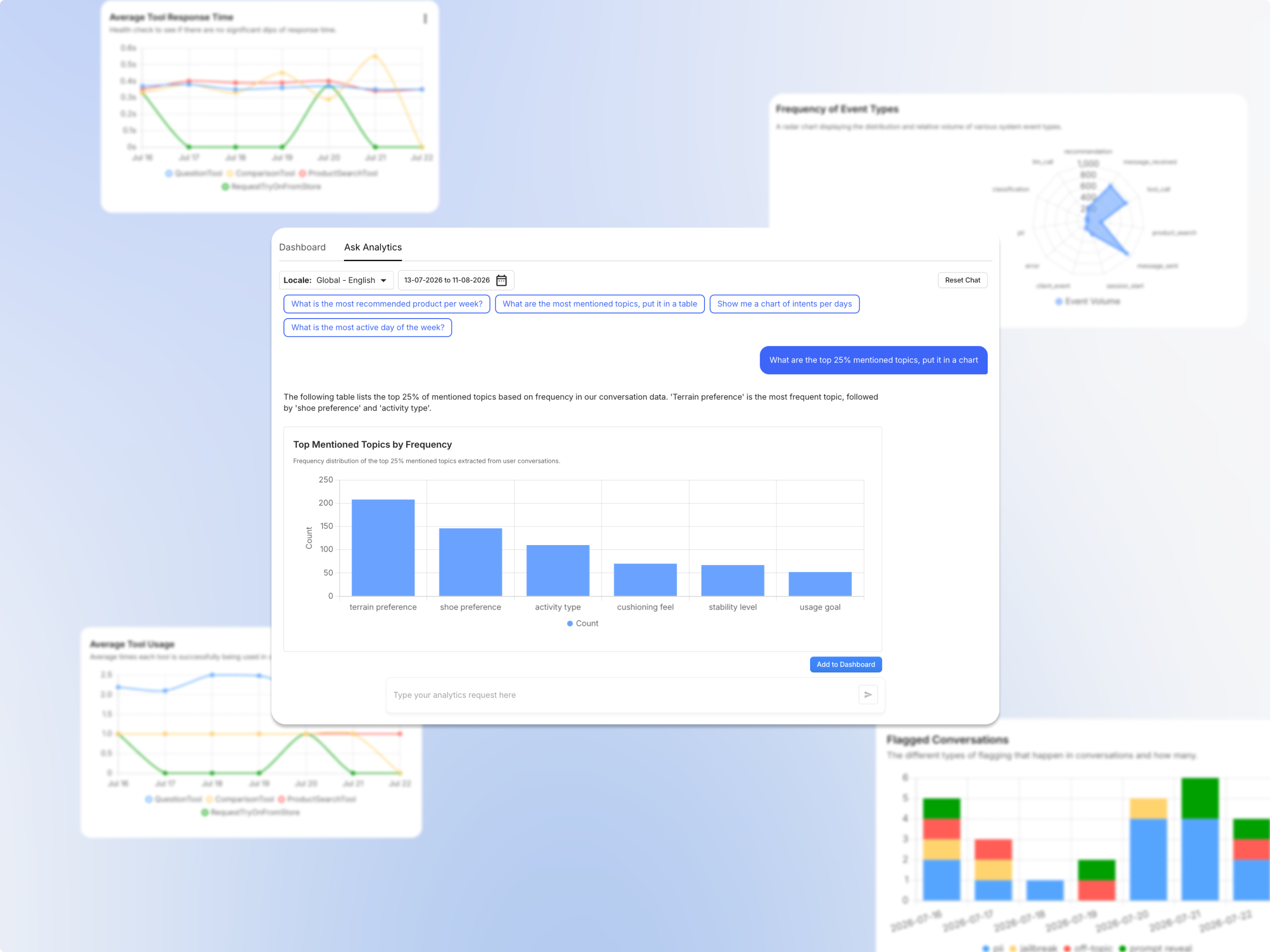
Sagent's Ask Analytics dashboard, showing conversation topics, flagged conversations, and event charts

Sagent, on your terms

You define the guardrails, tone, and business rules. Sagent stays inside them on every response, so you're always confident in what shoppers see

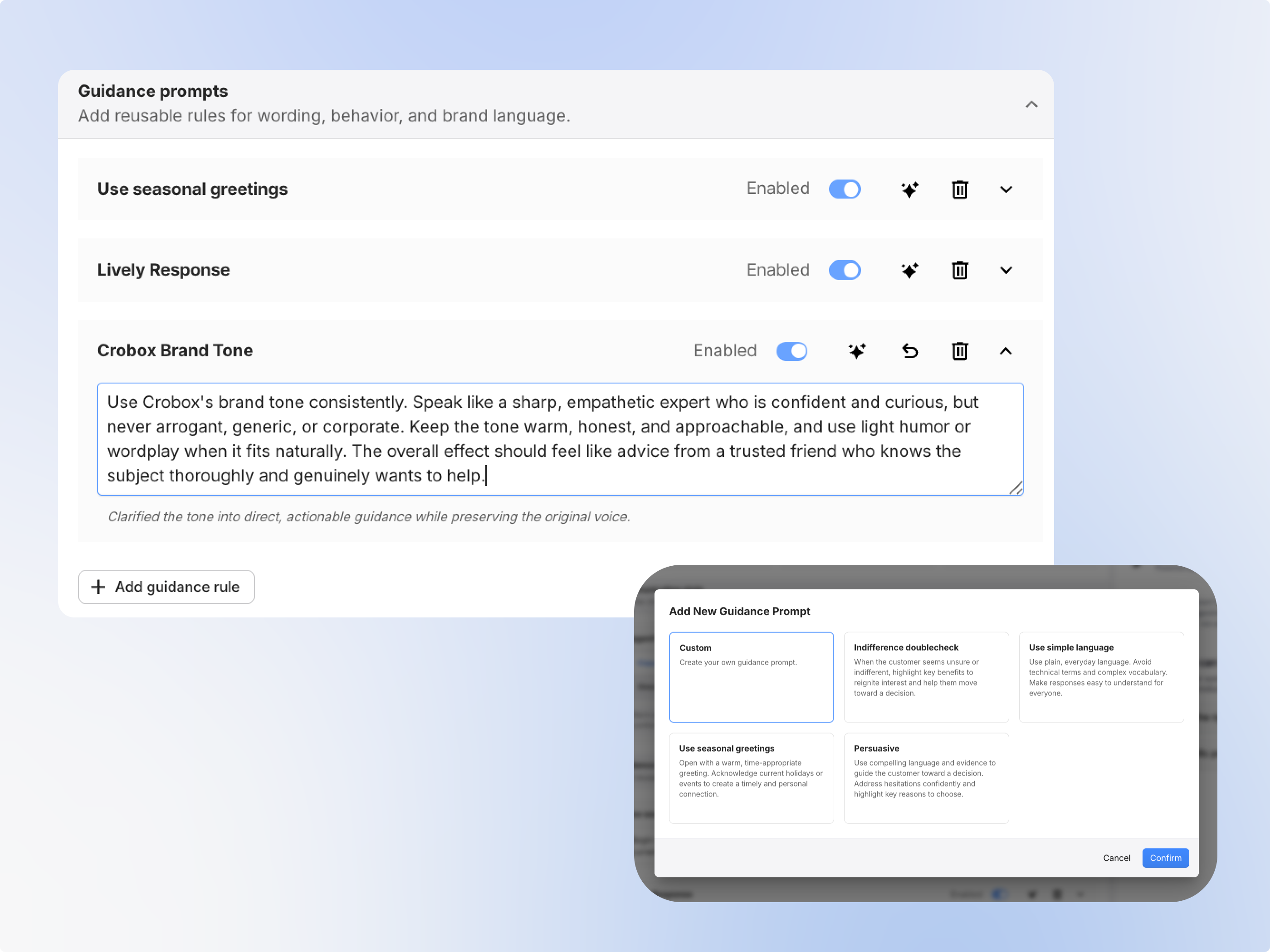
Guidance Prompts

Reusable rules for brand style and specific dos and don’ts, giving finer control than a single tone setting ever could
Guidance Prompts
Reusable rules for brand style and specific dos and don’ts, giving finer control than a single tone setting ever could
Guidance prompts configuration screen in the Sagent admin panel
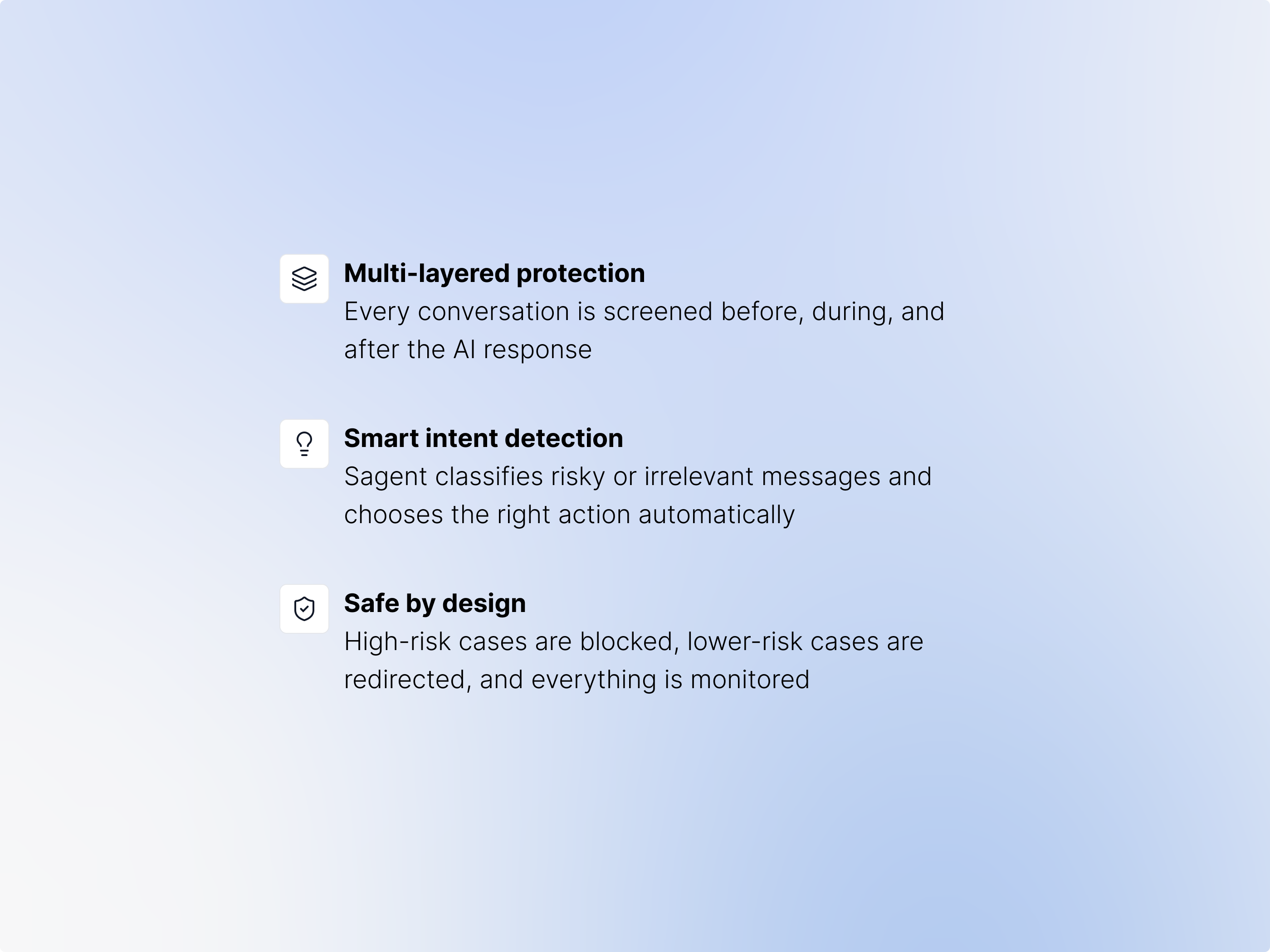
AI Guardrails
Every response is filtered before it reaches a shopper, so what it's asked and what it says always stays on-topic and on-brand
AI guardrails configuration screen in the Sagent admin panel
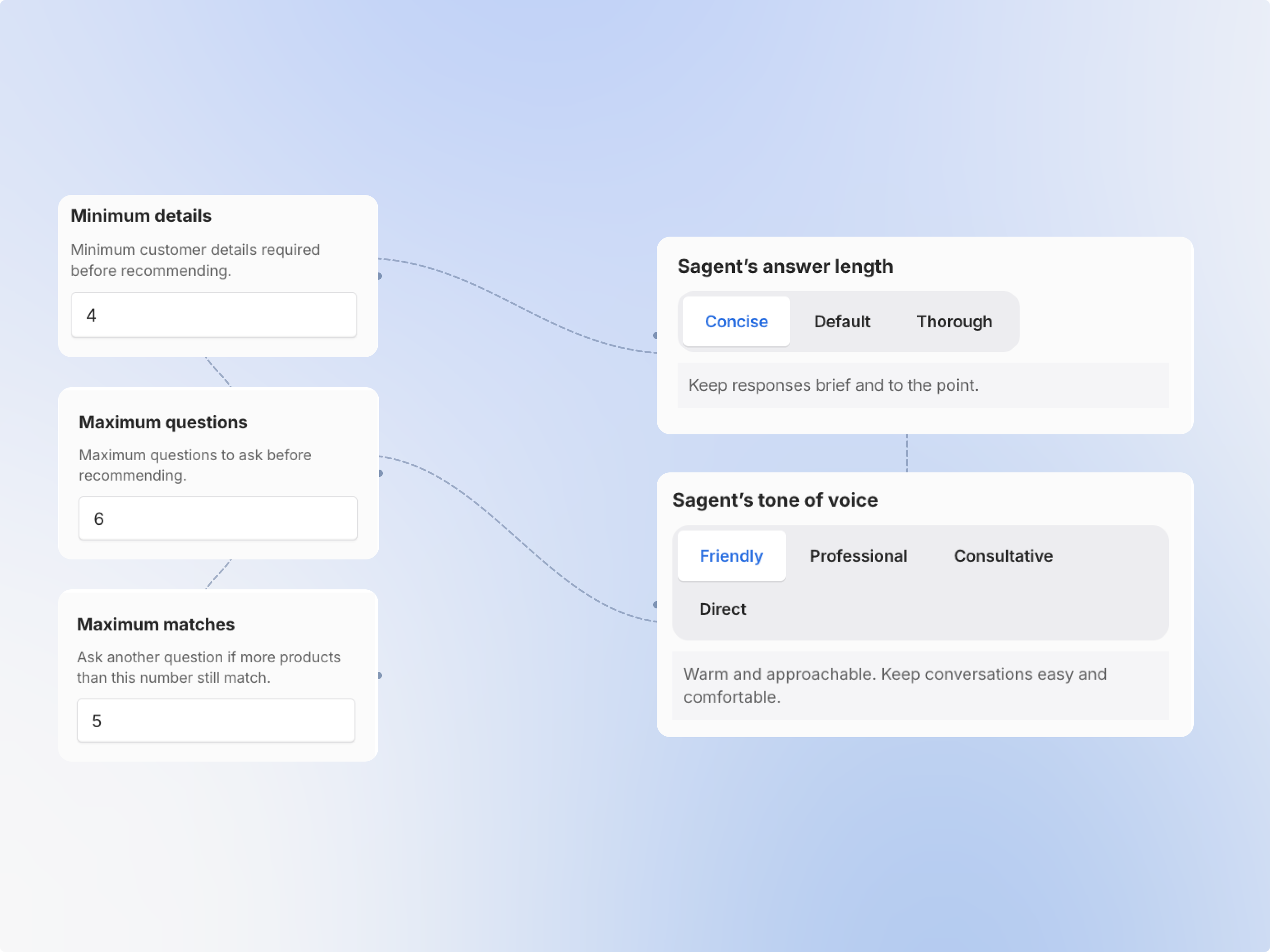
Tone & Response Length Presets
Friendly, professional, consultative, or direct, concise or thorough, set the voice once and it holds without an engineering ticket
Tone and response length presets screen in the Sagent admin panel
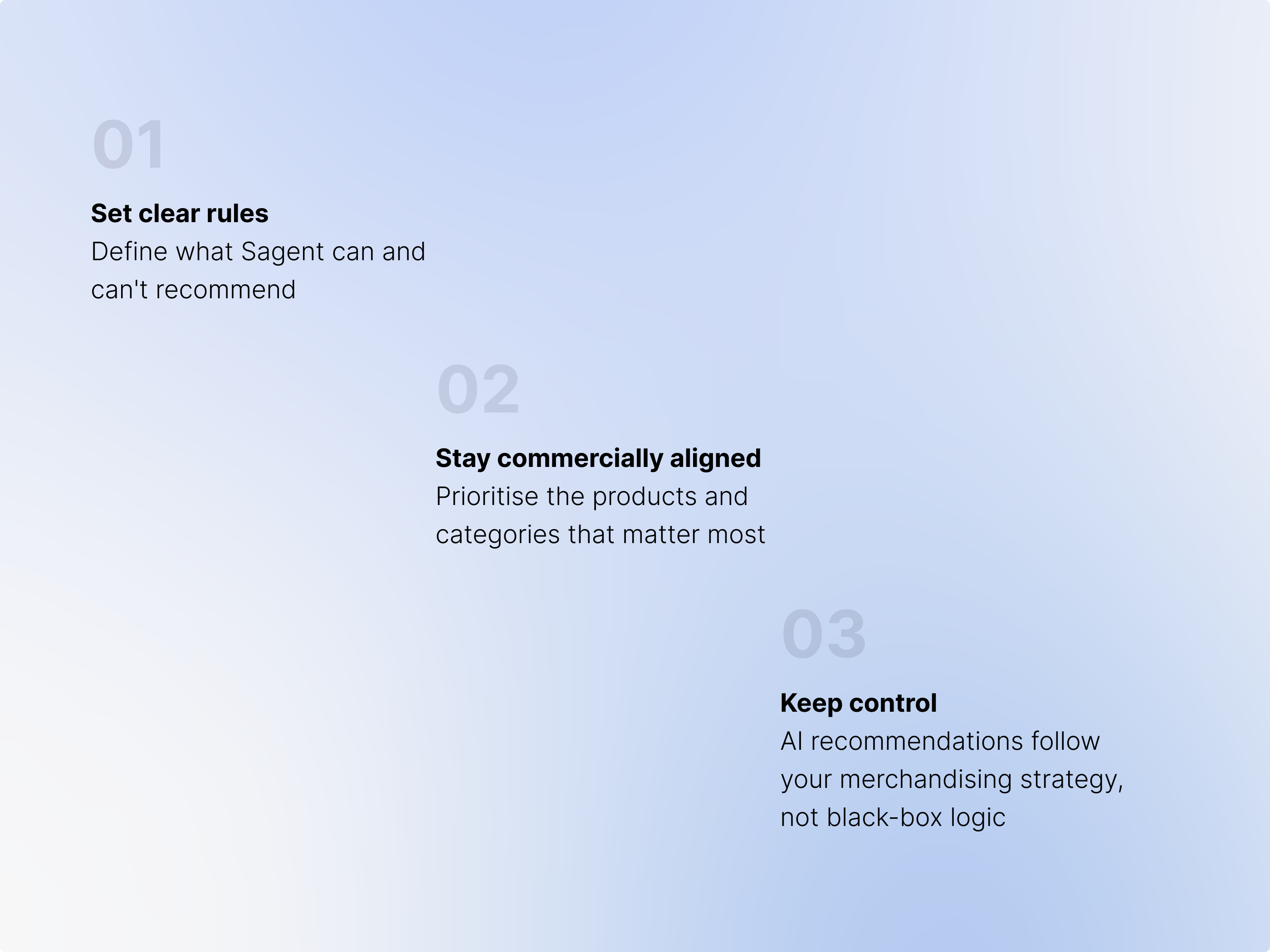
Business Rules
Exclude the outlet range, recommend only from certain categories, or always surface sustainable options, whatever your merchandising priorities are, Sagent works within them
Business rules configuration screen in the Sagent admin panel
Guidance prompts configuration screen in the Sagent admin panel

Deploy Sagent anywhere, anytime

One Sagent, configured once, meets shoppers wherever they are

Always-on widget

A consistent way in from anywhere on the site

Ask about this product

Scoped to a single product, for the shopper already looking at exactly one thing who wants a direct answer

QR Code activation

A code by the product turns a phone already in a shopper's hand into the same expert guidance your website gives

Conversation, with visuals

Text and visual product cards together, so browsing stays visual while the guidance sits on top

More capabilities, built in

A quick look at what else ships with Sagent

Guided Setup Flow

A guided process and lightweight implementation, with our team supporting you at every step

Live Preview & Test Mode

See and test the exact configured experience before it ever reaches a shopper

Dynamic Visitor Personalization

Recommendations adjust in real time to visitor-level data your team sends through

Adaptive Question Ranking

Questions are ranked by how much they narrow things down, not asked in a fixed, generic order

Brand Theming

Match your brand with no-code controls, or a full CSS override when you need more precision

Translations & Locale Support

Every market, every language, including the small print, generated for you

Custom Tools & Extensibility

Wire in proprietary sizing engines, loyalty systems, or other bespoke tools, built for technical teams who need it

Enterprise-grade security and compliance

EU AI Act disclosure built in
GDPR compliance
Never used to train outside models
See our security program →

Frequently asked questions

What is an AI shopping assistant?

An AI shopping assistant is a conversational layer on an ecommerce site that helps a shopper decide what to buy. It reads intent from plain language, asks a few clarifying questions, and narrows a large catalog down to the handful of products that genuinely fit. Unlike site search, it doesn't need the shopper to know the product name, and unlike a support chatbot, its job is the purchase decision rather than order status.

What can an AI shopping assistant do?

The capabilities that matter are: understanding a need described in the shopper's own words, asking adaptive follow-up questions instead of running a fixed quiz, recommending from your live catalog, and explaining the reasoning behind each recommendation. On top of that, an enterprise-grade assistant gives you control over tone, guardrails, and merchandising rules, works across every locale you sell in, and reports back on what shoppers actually asked.

What's the difference between an AI shopping assistant and a chatbot?

A support chatbot handles service questions: where is my order, how do I return this, what are your opening hours. An AI shopping assistant handles the decision: which of these 400 running shoes suits someone with wide feet who runs on wet trails. They draw on different data and are measured on different things. Chatbots are judged on deflection and resolution; a shopping assistant is judged on conversion, average order value, and return rate.

Do AI shopping assistants actually increase conversion?

They do when the recommendation is good enough to be trusted. Across live Crobox deployments we've measured a 5.2x return on investment at Osprey, 16x return on investment at ASICS, and a 604% conversion rate increase at Love Stories. The mechanism is behavioral rather than technical: shoppers who understand why a product fits them hesitate less, buy more confidently, and send fewer items back.

What product data does an AI shopping assistant need?

Your product feed is the starting point, but a raw feed is rarely enough. Feeds describe products in specifications; shoppers describe them in situations and benefits. Crobox Data Enrichment translates technical attributes into that shopper language and keeps it current as your catalog turns over, which is what lets the assistant answer a question like "something warm enough for a January commute" without guessing.

How long does it take to launch an AI shopping assistant?

With a usable product feed, a guided setup and a live preview mode get most brands to a testable assistant quickly, and our team supports each step rather than handing over a console. The work that takes real time is enrichment and tuning: agreeing which questions matter, which business rules apply, and how strongly to apply each persuasion principle. Book a demo and we'll walk through it against your own catalog.

Can we start with a pilot? What does that take in cost, time, and people?

Yes, one category and one market, live in two to four weeks depending on how fast your side can turn things around. Cost is a usage-based model, priced per conversation, so a pilot scoped to one category scales with the traffic you point at it rather than a fixed fee up front. Requirements: a product feed, a decision on the starting category, and one person who knows the catalog well enough to check the enrichment output, usually a few hours a week during setup.

Our store staff already do this well, and their knowledge took years to build. Can a tool really replicate that?

Your best associates ask two or three questions, listen, then translate the answers into a recommendation. Sagent runs that same pattern at 11pm on a phone, for the shoppers who will never walk into your store. The knowledge comes from your team, since we build the model with the people who know which jacket holds up through a wet autumn.

We have a product feed and access to LLMs. Why can't we build this ourselves?

You can point an LLM at your feed today and it will answer spec questions well. Shoppers ask in needs, something for wide feet that survives a wet winter, and a spec feed leaves the assistant guessing. Data Enrichment turns your technical attributes into that shopper language, and keeping it current as your catalog turns over is most of the build.

How much control do we have over what the AI says to our customers?

Sagent recommends products from your catalog, described with attributes you have approved, in your brand's tone. It has no route to inventing a product you don't sell, and when a shopper asks something outside its scope it says so and hands off. You set the boundaries before launch and review real conversations after.

Once it's running, who maintains it? Do we need someone in-house on this?

Enrichment runs continuously and flags missing or incomplete attributes with automated alerts, so gaps surface instead of sitting there. The enriched data exports back into your PIM, which improves your search and merchandising at the same time. Ownership sits with ecommerce or marketing, with a light review cadence.
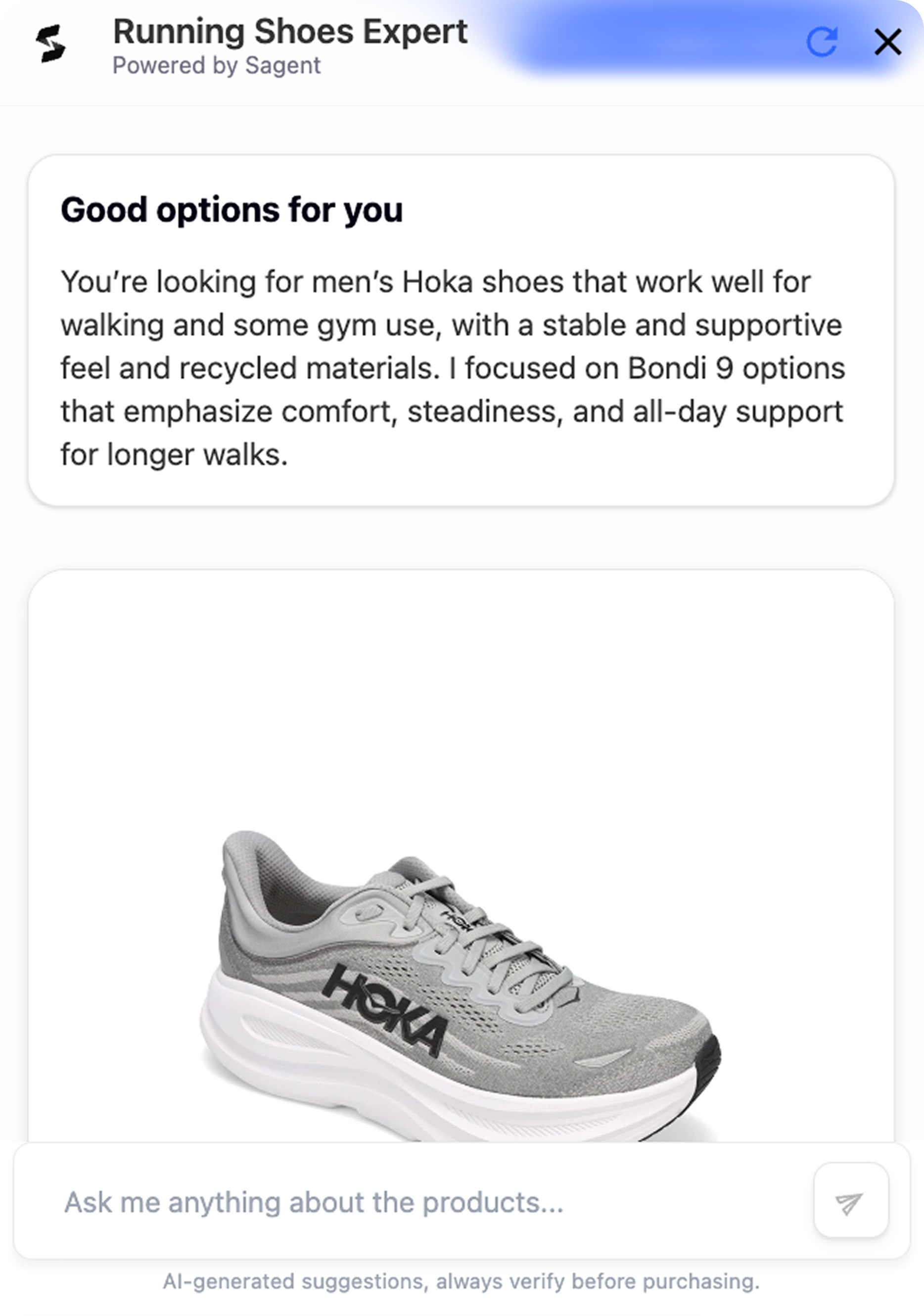
Sagent recommending a product with reasoning

Ready to see Sagent work on your product catalog?

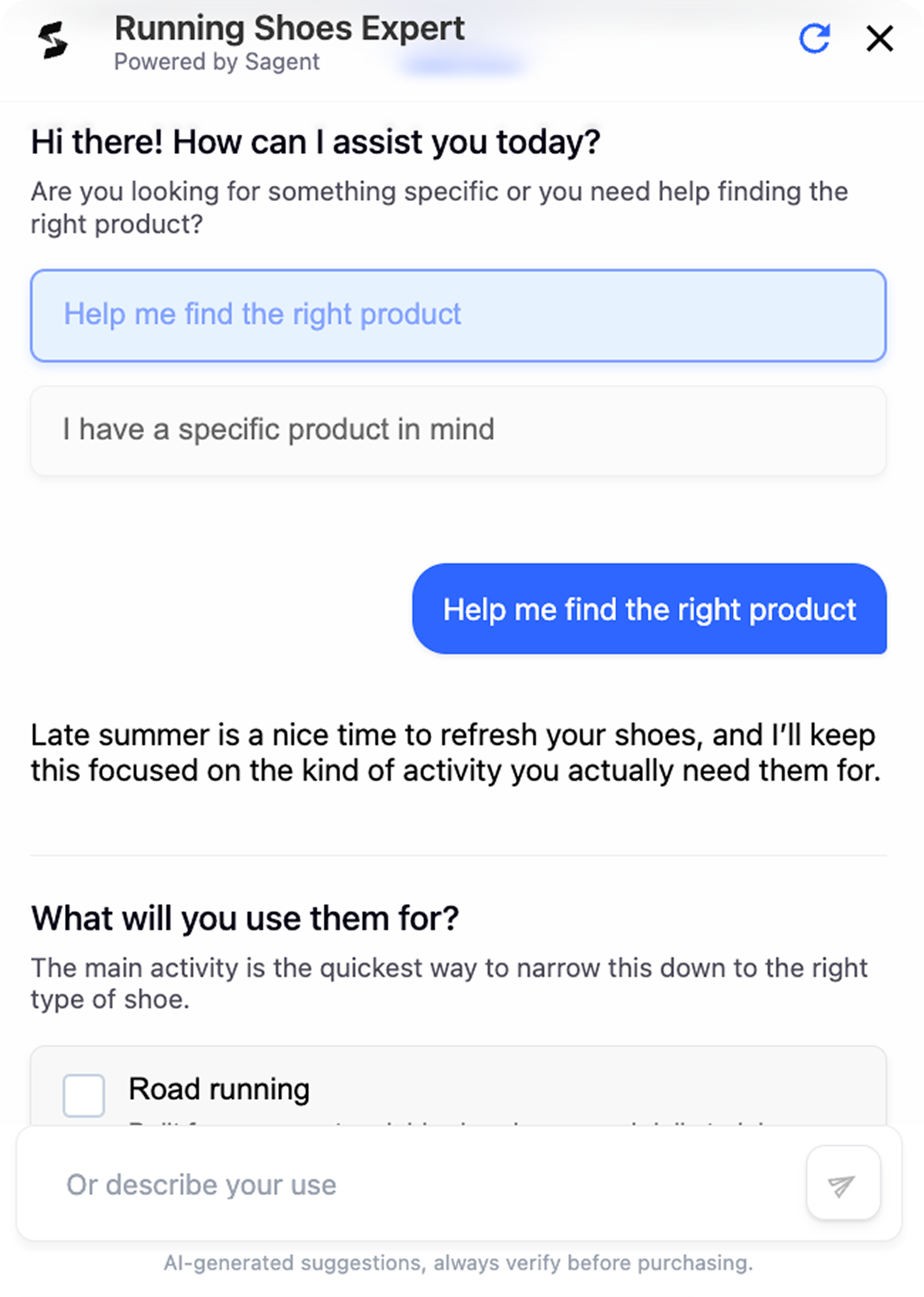
Sagent helping a shopper find the right product