
Cart Abandonment Behavior Signals: What AI Detects Before Shoppers Drop Off
Almost every abandoned cart is preceded by a minute or two of visible doubt.
The shopper went back to the product page. Then to a competitor’s tab. Then back again. They scrolled the reviews to the negative ones. They opened the size guide twice. They hovered over “Add to Cart” for four seconds before clicking, and then sat on the cart page doing nothing at all.
None of that shows up in your funnel report. It shows up as one number: they left.
Cart abandonment behavior signals are the observable patterns that precede a drop-off, and they’re the difference between a recovery strategy that fires after the fact and one that intervenes while the shopper is still on your site. Most ecommerce teams are still doing the former. Below is what the signals actually look like, why the biggest chunk of abandonment has nothing to do with your checkout, and how Crobox reads these signals in real time.
What are cart abandonment behavior signals?
A cart abandonment behavior signal is any measurable on-site action that correlates with a shopper leaving without buying. Some are obvious (idle time on the cart page). Most aren’t (repeated navigation between two product detail pages, which usually means the shopper can’t tell the two products apart).
They fall into three groups:
- Hesitation signals — the shopper is engaged but can’t decide. Long dwell times without interaction, cursor drift toward the browser chrome, repeated scroll-ups to re-read a spec.
- Confusion signals — the shopper wants information the page isn’t giving them. Size-guide opens, search queries fired from a product page, reviews filtered to one star.
- Friction signals — the shopper has decided but the path is blocking them. Form-field re-entry, promo-code field focus, back-navigation from the shipping step.
The distinction matters because each group needs a completely different response. Firing a discount at a confusion signal wastes margin on someone who would have bought at full price if they’d just known whether the jacket runs small. That’s the core mistake in most abandonment programs: one lever, applied to three different problems.
Why most cart abandonment isn’t a checkout problem
Here’s the number that reframes the whole discussion. Baymard Institute’s aggregate of 50 studies puts the average documented cart abandonment rate at 70.22%. But when they ask shoppers why, 42% say they were just browsing or not ready to buy.
Read that again. The single largest cause of cart abandonment isn’t shipping cost, and it isn’t a clunky checkout. It’s indecision.
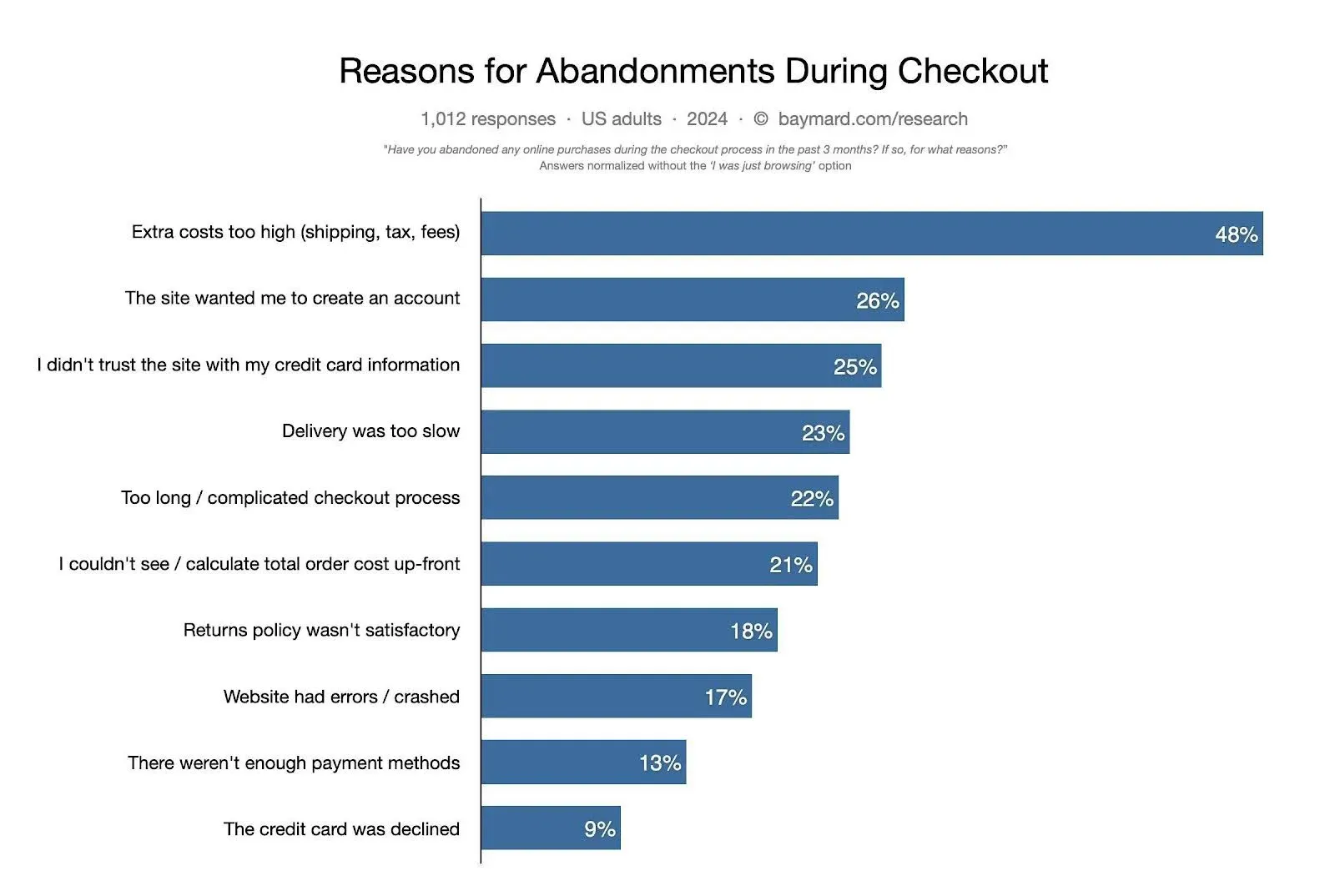
Extra costs are the top addressable reason, as the chart above shows, and there’s real money in fixing checkout UX. Baymard estimates the average large ecommerce site could gain a 35% lift in conversion rate from better checkout design alone. That work is worth doing, and we’ve covered the tactical side of it in our guide to reducing cart abandonment.
But if you only optimize checkout, you’re competing for the 58% while ignoring the 42%. And the 42% is where behavioral signals earn their keep, because indecision is the one cause that announces itself before the shopper leaves.
Why does indecision run so high? Because you gave them too much to choose from. Iyengar and Lepper’s famous jam study found that shoppers presented with 24 varieties bought at a rate of 3%, while shoppers presented with six bought at 30% (Columbia Business School). A tenfold difference, from nothing but the size of the option set.
Your catalog has more than 24 options. Choice overload is not an edge case in ecommerce; it’s the default condition, and an abandoned cart is often just what decision fatigue looks like in an analytics dashboard.
The 7 strongest cart abandonment behavior signals
Not all signals predict equally. These are the seven we’ve found carry the most weight, roughly in order of how reliably they precede a drop-off.
1. Back-and-forth between two product pages
A shopper toggling between two PDPs three or more times is not comparison shopping in a healthy way. They’re stuck. The products are similar enough that the differences on the page don’t resolve the decision, which means your product data isn’t answering the question they’re actually asking.
This is the highest-intent signal on the list. The shopper wants to buy. They just can’t tell which one.
2. Stalled scroll on the cart page
Scroll velocity drops to zero and stays there for 15+ seconds with no click. Classic pre-abandonment. On the cart page specifically, the shopper is doing mental arithmetic: total cost, whether they need it, whether they’ll return it.
3. Repeated size-guide or spec-sheet opens
Two or more opens of the same reference material means the guide isn’t answering the question. Often the shopper is trying to map their own body or use case onto an abstract chart, and failing.
4. Reviews filtered to the lowest ratings
A shopper who jumps straight to one- and two-star reviews is looking for a reason not to buy. They’re pre-loading regret avoidance. This is a strong signal and a fragile one; the wrong intervention here reads as pushy.
5. Cursor drift toward the tab bar or back button
Exit-intent detection is old, but the useful version isn’t the binary “mouse left the viewport” trigger. It’s the deceleration pattern in the seconds before, combined with what the shopper was doing when it started.
6. Search fired from a product detail page
The shopper is on a product page and opens site search anyway. That’s a direct statement that this product isn’t it and your navigation didn’t offer an obvious next step. High abandonment correlation, and almost entirely a discovery failure rather than a checkout one.
7. Promo-code field focus without a code
Clicking into the discount box and typing nothing is one of the most reliable signals in ecommerce. The shopper has decided the price is too high and gone looking for a way around it. Often they leave the site to search for a coupon and never come back.
The pattern across all seven: five of the seven are decision signals, not checkout signals. They fire long before the shopper reaches your payment step.
How Crobox detects cart abandonment behavior signals in real time
Detecting signals is the easy part. Most session-replay and analytics tools can already tell you a shopper bounced between two PDPs. What they can’t do is act on it in the moment, because they don’t understand your products well enough to say anything useful.
That’s where the work actually is.
It starts with product data. A feed that says Gore-Tex, 4mm drop, 280g cannot resolve a shopper’s hesitation, because the shopper’s question is “will my feet stay dry on a wet commute?” Nothing in the feed connects those two sentences. Crobox Data Enrichment translates technical attributes into the benefits, situations, and language shoppers use, and keeps doing it as your catalog turns over. Without that layer, every intervention is a guess dressed up as personalization.
Then it reads intent, continuously. Crobox tracks behavioral signals across the session rather than at a single trigger point, building a live picture of what the shopper is trying to work out. Two similar PDPs viewed repeatedly means a differentiation problem. Repeated size-guide opens means a fit problem. Those need different answers.
Then it intervenes with the right thing. This is the part most tools get wrong. Options include:
- A Product Finder that steps in with three questions and narrows the catalog to two options. Best for the shopper who is overwhelmed rather than undecided between specific items.
- An AI shopping assistant that lets them ask the question directly, in their own words, and explains why one product fits better than the other. That’s what Sagent does, and it’s the natural response to a hesitation signal because hesitation is usually an unanswered question.
- A behavioral nudge: social proof, scarcity, or a benefit reframe, chosen for the specific principle that moves that specific doubt.
Across our deployments, guided discovery of this kind drives +259% conversion rate uplift, +15% average order value, and 4.7x ROI. Not because it recovers carts, but because it stops them being abandoned in the first place.
And it never leads with a discount. Discounting a hesitation signal trains shoppers to hesitate. It also hands margin to people who were going to buy anyway. Save the price lever for the promo-code signal, where price genuinely is the objection.
What acting on signals looks like: ASICS
ASICS had the problem every technical-product retailer has. Running shoes are differentiated by attributes most shoppers can’t self-diagnose: pronation, drop, stack height, surface. The catalog was full of the right shoe for everyone, and shoppers couldn’t find theirs.
The behavior signals were textbook. Long dwell times on comparison-heavy category pages, repeated PDP toggling, heavy use of filters that shoppers then cleared.
The response wasn’t a checkout redesign or an abandonment email sequence. It was a Shoe Finder: a guided flow that asks about running surface, distance, and previous injuries, then explains its recommendation in terms the shopper already understands. Crobox and ASICS have run and refined it since 2017.
The results: 16x ROI, a 52% increase in conversion rate, and +15% average order value. The abandonment those shoppers would have generated never happened, because the decision got resolved on the way in rather than salvaged on the way out.
That’s the strategic point. The best cart abandonment program is the one that reduces the number of shoppers who reach the cart uncertain.
How to turn signals into recovery tactics
If you want to build this out, the sequence that works:
1. Instrument the decision phase, not just the funnel. Most analytics stacks track page views and add-to-carts. Add events for the seven signals above. You cannot act on what you don’t record, and the majority of these fire well before checkout.
2. Segment by signal type, not by cart value. A €400 cart abandoned on a confusion signal and a €400 cart abandoned on a friction signal are different customers with different fixes. Cart-value segmentation is the laziest cut in the industry and it’s why so many abandonment programs plateau.
3. Match the intervention to the psychology. Hesitation wants clarity. Confusion wants information. Friction wants removal. Price objection wants a reason the price is fair, or, occasionally, a lower one. We’ve written more on the personalization side of this in our guide to ecommerce cart abandonment.
4. Fix the upstream cause. If the same signal fires on the same product week after week, that’s not an abandonment problem. That’s a product-data problem, and enrichment will beat any recovery tactic you layer on top of it.
5. Then run the email. Abandoned cart emails still work, and the global abandonment rate tracked by Statista is high enough that they’ll keep paying for themselves. But they’re the last resort in this list, not the first, because by the time one sends, the shopper’s context is gone and you’re competing with everything else in their inbox.
FAQ
What are cart abandonment behavior signals? Observable on-site actions that predict a shopper will leave without buying. They split into hesitation signals (indecision), confusion signals (missing information), and friction signals (blocked path), and each needs a different response.
Which cart abandonment signal is the strongest predictor? Repeated back-and-forth navigation between two similar product pages. It’s a high-intent signal: the shopper wants to buy, but the product pages aren’t giving them a basis to choose.
Can AI actually reduce cart abandonment, or just detect it? Both, but only if it understands your products. Detection is commodity technology at this point. The value is in responding with something specific, which requires enriched product data underneath the model rather than a raw spec feed.
Should I use discounts to recover abandoned carts? Sparingly, and only against genuine price objections such as the promo-code signal. Discounting hesitation teaches shoppers that waiting is profitable, and it erodes margin on customers who would have converted anyway.
How early can you detect cart abandonment risk? Well before the cart. Five of the seven strongest signals fire during product discovery, which is why interventions placed at the decision point outperform ones placed at checkout.
The takeaway
Cart abandonment gets treated as a checkout problem because that’s where it’s measured. It’s mostly a decision problem, and decisions leave a trail.
Read the trail, understand which kind of doubt you’re looking at, and answer it with something better than 10% off. The shoppers who abandon because they’re overwhelmed were never lost to your competitor. They were lost to your catalog.
Want to see which signals your shoppers are firing right now, and what Crobox would do about them? Book a demo and we’ll walk through it on your own products.